10-02-2026
The Forest Bureau of Investigation begins its implementation in Cyprus
Dozens of students aged 4 to 12 will head outdoors to learn about the environment
By Dr. Michalis Ierides, Secretary General of CYMEPA
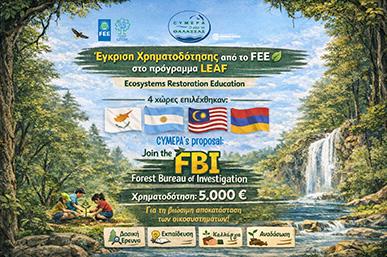
This week we will be delivering to educators the backpacks containing the equipment they will use to teach students participating in the FBI – Forest Bureau of Investigation project. To some, this may seem like just another logistical detail of an educational programme. For us at CYMEPA, however, this moment carries deeper meaning: it marks the transition from theory to practice, from planning to a living learning experience.
The FBI project was born out of a simple yet fundamental realisation: we cannot talk to children about environmental protection unless we first give them the opportunity to get to know the environment. Not through slides and textbooks, but through direct contact with the forest, observation, discovery and—above all—curiosity.
Backpacks into the forest!
When we designed CYMEPA’s proposal, our goal was not merely to create an “attractive” programme. We wanted something meaningful, experiential and practical—something that could genuinely be integrated into everyday school life. The fact that the project was recognised internationally within the framework of the LEAF Programme, among dozens of proposals, confirmed that this direction was the right one.
The backpacks we are delivering are not simply “educational material”. They are empowerment tools. With them, students become young investigators: they observe traces, study biodiversity, and understand how forests or grasslands are connected to our food, our health and our quality of life. They learn to ask questions and to seek answers—skills that are valuable far beyond the environmental field.
Teachers as the key
We place particular emphasis on the role of educators. The FBI project was designed to support them in a practical way, offering structured tools, clear guidance and flexibility. We are not asking teachers to “add more weight” to their curriculum, but to gain a resource that enriches their teaching.
In an era when environmental crises often seem abstract or distant, I firmly believe that the answer lies in education that starts early and is based on experiential learning. If children learn to love and understand the natural environment, they will protect it not because they “have to”, but because they feel it is their own. And this is the true goal of the FBI project.
Young people at the core
As an organisation, in the majority of our actions we systematically involve young students in cooperation with the Ministry of Education, Sport and Youth, because we are convinced that environmental awareness is not “cultivated” through declarations, but through proper education and hands-on engagement from an early age. This commitment is not new; it has been an integral part of our philosophy since the very beginning of our operation.
A prime example is the Adopt a Ship programme, implemented in cooperation with the Cyprus Shipping Chamber, which this year marks approximately 20 years of successful implementation. The programme has brought dozens of students into direct contact with issues of shipping, safety at sea and marine environmental protection, through partnerships with ships and maritime professionals. It also broadens young people’s horizons by introducing them to employment opportunities in the blue professions.
Only by investing in the knowledge and lived experiences of young people will we see the profound changes we all envision for our environment and for sustainable development. And this is precisely what we strive for through every one of our initiatives.